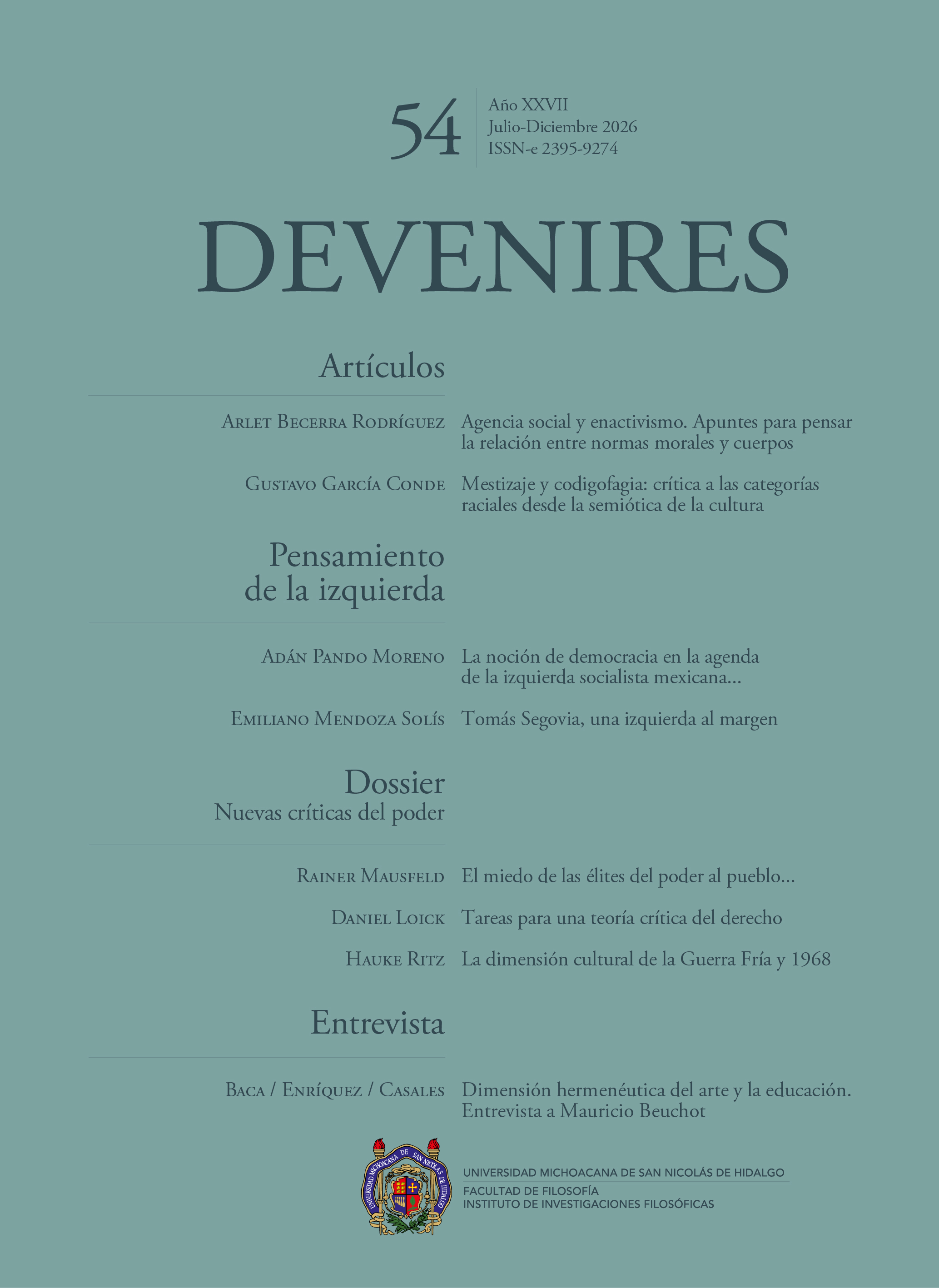
Tomás Segovia, a left on the margin
DOI:
https://doi.org/10.35830/vac3bs81Keywords:
exile, uprootedness, childhood, Neozapatism, social protestAbstract
The paper explores the conception of the political left of the writer Tomás Segovia (Spain, 1927 - Mexico 2011). Segovia is part of the so-called children of the Spanish exile of 1939; his political ideas are marked by the experience of exile. From that childhood experience, he produces an extraordinary poetic and essayistic work. His political reflections arise from a particular idea of uprootedness, not in the distorted sense that the term acquires in a globalized world; on the contrary, uprootedness is seen as the result of a critique of all identity or nationalistic claims. From this general conception, Segovia addresses different problematic issues of the politics of the last decades of the 20th century and the first decades of the 21st century, such as representative democracy, institutional politics, the nature of power and the critique of the idea of progress. A conception of the left with these characteristics can be qualified as “marginal” insofar as it does not belong to a political movement or party. A review of the Latin American left is incomplete if we fail to take into account the expressions that remain on the margins of academic and ideological discussion.
References
Agamben, G., (2017) Homo sacer. El poder soberano y la vida desnuda. Argentina: Adriana Hidalgo editora.
Agamben G., (1996). Políticas del exilio. España: Archipiélago. Cuadernos de crítica de la cultura.
Arendt, H., (2019). La pluralidad del mundo. México: Taurus.
Benjamin, W., (2008). Tesis sobre la historia y otros fragmentos. México: UACM- ITACA.
Hölderlin, F. (1998), Hiperión o el eremita en Grecia. Madrid: Hiperión.
Hernández Navarro, L. (2005). Tomás Segovia. Elogio a la resistencia, La jornada, 6 de diciembre.
Espinasa, J. M., (2006) La poesía de Tomás Segovia, La gaceta. Número 254, México: FCE.
Mendoza Solís, E. (2021). Un método sin fin. Experiencia e historia a partir del concepto de obra de arte en Walter Benjamin. Inflexiones, 07, 109–124.
Paz, O, (2008) Cartas a Tomás Segovia (1957-1985). México: FCE.
Segovia, T. (2005), Alegatorio. México: Ediciones sin nombre.
Segovia, T. (2009a) Marginalidad y exilio (entrevista con J. R. Ripoll). Campo de Agramante: revista de literatura, núm. 12.
Segovia T. (2009b). El exilio en el recuerdo: "No hay identidad, hay identificación". Entrevista al poeta Tomás Segovia en La República y la cultura: paz, guerra y exilio. España: Akal.
Segovia, T. (2009c). Sin nada en otro sitio. España. Delegación de Cultura y Patrimonio, Excmo. Ayuntamiento de Granada.
Segovia, T. (2011). Digo yo. México: FCE.
Segovia, T. (2014). Cuadernos del nómada, Volumen I (1943-1998). México: FCE.
Segovia, T., (2016). Poética y profética. México: FCE.
Villoro, L. (2015). La alternativa. Perspectivas y posibilidades de cambio. México: FCE.
Downloads
Published
Issue
Section
License
Copyright (c) 2026 UMSNH

This work is licensed under a Creative Commons Attribution-NonCommercial-NoDerivatives 4.0 International License.
 Devenires, Año XXVII, Núm. 54, Julio-Diciembre 2026 es una publicación semestral editada por la Universidad Michoacana de San Nicolás de Hidalgo (Santiago Tapia 403, Centro Histórico, Morelia, Michoacán, México, C.P. 58000, Tel. (+52) 44-3322-3500), a través de la Facultad de Filosofía y el Instituto de Investigaciones Filosóficas (Ciudad Universitaria, Edificio C-4, Morelia, Michoacán, México, C.P. 58030, Tel (+52) 44-3322-3500 ext. 4148). Editor responsable: Dr. Federico Marulanda Rey (