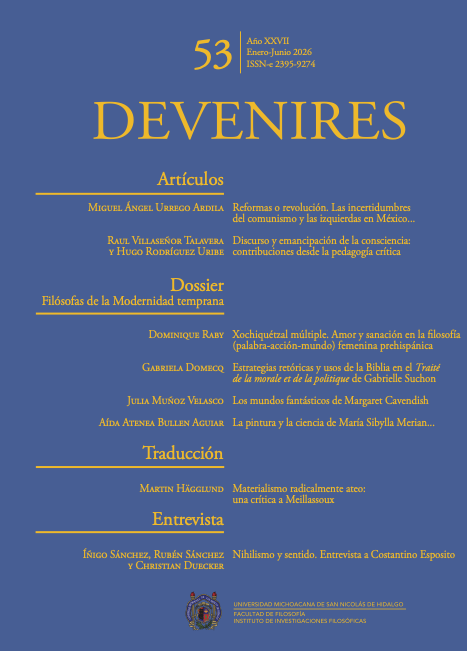
La pintura y la ciencia de María Sibylla Merian
Entre la arqueología del saber y el análisis de la teoría del punto de vista
DOI:
https://doi.org/10.35830/devenires.v27i53.1034Palabras clave:
historia de las mujeres, episteme, arte, ecologíaResumen
Con la intención de dimensionar los aportes del María Sibylla Merian a la biología, particularmente a los campos especializados de la entomología y la ecología, se retoma la noción de episteme que aparece en la Arqueología del Saber de Michel Foucault y se complementa con la Teoría del Punto de Vista de la epistemología feminista de Nancy Hartsock y Patricia Hill-Collins. El texto intenta responder ¿De qué manera María Sibylla Merian rompe con el esquema epistemológico propuesto por Foucault? ¿Es capaz de transgredir la episteme renacentista, clásica y moderna? ¿De qué manera la Teoría del Punto de Vista puede explicar su singularidad? En respuesta a estas preguntas se encuentra que la posición liminal de Merian, le permite realizar observaciones y explorar el mundo natural, sin limitaciones. Transita de la episteme renacentista -a través de la pintura floral-, a la episteme clásica a partir de sus observaciones respecto a las relaciones tróficas e interespecíficas. Vislumbra también, el papel del ser humano en la deforestación y destrucción de los bosques tropicales húmedos de Surinam.
Referencias
Descartes, R. (2010). El discurso del método. Colección Austral Espasa-Calpe.
Etheridge, K. (2022). The world of Maria Sibylla Merian. En B. van de Roemer, F. Pieters, H, Mulder, K. Etheridge & M. van Delft (Eds.), Changing the nature of art and science, (24- 32). Lannoo Publishers.
Etheridge, K. (2011). Maria Sibylla Merian: The First Ecologist? En D. S. Andréolle y V. Molinari (Eds.), Women and Science: Figures and Representations-17th century to present, (31-61). Cambridge Scholars Publishing.
Espinosa Miñoso, Y. (2012). De por qué es necesario un feminismo descolonial: diferenciación, dominación co-constitutiva de la modernidad occidental y el fin de la política de identidad. Solar, 12(1), 141-171. https://om.juscatamarca.gob.ar/ articulos/De_por_que_es_necesario_un_feminismo_des.pdf
Foucault, M. 2007a. Las palabras y las cosas. Siglo XXI.
Foucault, M. 2007b. La arqueología del saber. Siglo XXI.
German History Intersections (29 de Agosto 2025). Maria Sibylla Merian, Butterflies, Beetles, and Other Insects (18th Century). https://germanhistory-intersections.org/en/knowledge-and-education/ghis:document-168
Harding, S. (1993). Rethinking Standpoint Epistemology: What is Strong Objectivity? En: Alcoff, L. y Potter, E (Eds), Feminist epistemologies, (49-82). Routledge.
Hartsock, N. (1983). The Feminist Standpoint: Developing the Ground for a Specifically Feminist Historical Materialism. En S. Harding y. M. Hintikka (Eds.) Discovering reality: feminist perspectives on epistemology, metaphysics, methodology, and philosophy of science (283-310). Kluwer Academic Publishers.
Heard, K. (2016). Maria Merian’s Butterflies. London: Royal Collection Trust.
Hill-Collins, P. (1986). Learning from the Outsider Within: The Sociological Significance of Black Feminist Thought. Social Problems, 33(6), 14-32. https://www.jstor.org/stable/800672
Keller, E.F- (1983). Gender and Science. En S. Harding y. M. Hintikka (Eds.), Dis- covering reality: feminist perspectives on epistemology, metaphysics, methodology, and philosophy of science (187-203). Kluwer Academic Publishers.
Kuhn, T. (2006). La estructura de las revoluciones científicas. Fondo de Cultura Económica. Linné, C. (1735). Systema naturae, sive regna tria naturae systematice proposita per classes, ordines, genera et species. Lugduni Batavorum: Apud Theodorum Haak, ex Typographia Joannis Wilhelmi de Groot. https://bibdigital.rjb.csic.es/idurl/1/10688
Lugones, M. (2011). Hacia un feminismo descolonial. La manzana de la Discordia. 6 (2), 105-119. https://hum.unne.edu.ar/generoysex/seminario1/s1_18.pdf
Lugones, M. (2008). Colonialidad y género. Tabula Rasa, 9, 73-101. https://www.revistatabularasa.org/numero-9/05lugones.pdf
Mariath, F. y Baratto, L. (2023). Journal of Ethnobiology and Ethnomedicine. Female naturalist and the patterns of suppression of women scientists in history: the example of María Sibylla Merian and her contributions about useful plant. 19(17). https://doi.org/10.1186/s13002-023-00589-1
Paravisini-Gebert, L. (2012). Maria Sibylla Merian: The Dawn of Field Ecology in the Forests of Suriname, 1699-1701. Review Literature and Arts of the Americas. 41(1). https://www.tandfonline.com/doi/abs/10.1080/08905762.2012.670450
Polcha, E. (2019). Breeding Insects and Reproducing White Supremacy in Maria Sibylla Merian’s Ecology of Dispossession. Lady science. https://www.ladyscience.com/ breedinginsects-and-reproducing-white-supremacy/no57
Quijano, A. (1992). Colonialidad y modernidad/racionalidad. Perú indígena, 13(29), 11-20. https://www.lavaca.org/wp-content/uploads/2016/04/quijano.pdf
Schiebinger L. (2004) Nature’s body: gender in the making of the modern science. Rutgers University Press.
Descargas
Publicado
Número
Sección
Licencia
Derechos de autor 2025 UMSNH

Esta obra está bajo una licencia internacional Creative Commons Atribución-NoComercial-SinDerivadas 4.0.
 Devenires, Año XXVII, Núm. 53, Enero-Junio 2026 es una publicación semestral editada por la Universidad Michoacana de San Nicolás de Hidalgo (Santiago Tapia 403, Centro Histórico, Morelia, Michoacán, México, C.P. 58000, Tel. (+52) 44-3322-3500), a través de la Facultad de Filosofía y el Instituto de Investigaciones Filosóficas (Ciudad Universitaria, Edificio C-4, Morelia, Michoacán, México, C.P. 58030, Tel (+52) 44-3322-3500 ext. 4148). Editor responsable: Dr. Federico Marulanda Rey (