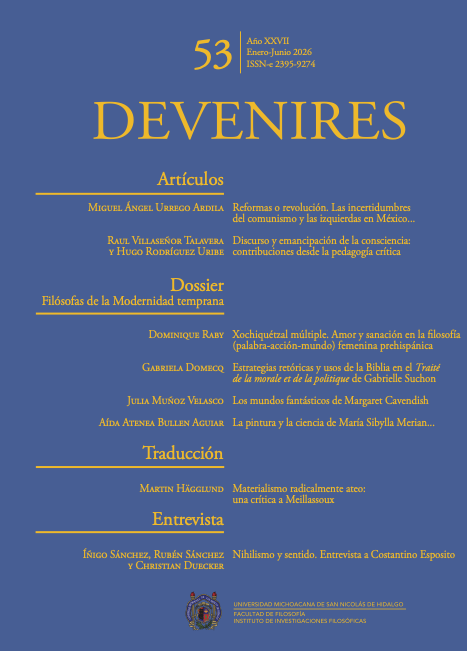
Los mundos fantásticos de Margaret Cavendish
DOI:
https://doi.org/10.35830/devenires.v27i53.1036Palabras clave:
fantasía, ficción, filosofía natural, pansiquismoResumen
El presente artículo tiene como objetivo argumentar que la postura filosófica pansiquista de Cavendish necesita de la fantasía para ser explicada y comprendida. Esto se debe a que dicha facultad permite experimentar versiones del mundo que podrían parecernos, a primera vista, ajenas; pero que podemos reconsiderar filosóficamente tras familiarizarnos con ellas desde la ficción. El gran valor epistémico que Cavendish confiere a la fantasía es algo que se ha estudiado ampliamente dentro de la bibliografía secundaria. Aquí, sin embargo, se analizará únicamente la importancia que Cavendish confiere a la fantasía para el quehacer filosófico.
Referencias
Aristóteles. (1974). Poética. Edición trilingüe: griego, latín, español. Introducción, traducción al español, notas y apéndices de Valentín García Yebra. Madrid: Editorial Gredos, Biblioteca Románica Hispánica.
Battigelli, A. (1998). Margaret Cavendish and the Exiles of the Mind. Kentucky: The University Press of Kentucky.
Cavendish, M. (2019). Essential Writings. D. Cunning (ed.) Oxford University Press. Cavendish, M. (2017). El mundo resplandeciente. Madrid: Siruela.
Cavendish, M. (2001). Observations Upon Experimental Philosophy. E. O’Neill (ed.). Cambridge: Cambridge University Press.
Cavendish, M. (s.f.) Philosophicall fancies. Written by the Right Honourable, the Lady Newcastle. En Early English Books Online. https://name.umdl.umich.edu/A53057.0001.001. University of Michigan Library Digital Collections.
Cunning, D. (2022). “Margaret Lucas Cavendish”, The Stanford Encyclopedia of Philosophy. E. N. Zalta y U. Nodelman (eds.), https://plato.stanford.edu/archives/win2022/entries/margaret-cavendish/
Descartes, R. (2005). Meditaciones Metafísicas, con objeciones y respuestas. Oviedo: KRK ediciones.
Findlen, P. (2006). “Between Carnival and Lent: The Scientific Revolution at the Margins of Culture”. En Collins, J. B., & Taylor, K. L. (ed.) Early Modern Europe: Issues and Interpretations. Blackwell Publishing.
Lasa, C. (2021). Marcos para la utopía de la mujer que escribe: Notas a The Blazing World, de Margaret Cavendish, y la relación con sus poemas científicos; Stultifera Navis; 2; 4; 9-2021; 1-11.
Lavié, C. (2022). Fancy, Sense, Wit: modos de la razón en la filosofía feminista de Margaret Cavendish. Siglo Dieciocho, 3, 17-40.
Leslie, M. (2012). Mind the Map: Fancy, Matter, and World Construction in Margaret Cavendish’s “Blazing World”. Renaissance and Reformation, 35(1), 85-112. https://doi.org/10.33137/rr.v35i1.19076
Leslie, M. (1996). Gender, Genre and the Utopian Body in Margaret Cavendish’s Blazing World. Utopian Studies, 7(1), 6-24.
Manzo, S. (2023). Margaret Cavendish acerca del escepticismo, los sueños y la fanta- sía (fancy). Ideas y Valores, 72 (Supl. 10), 93-115.
Nussbaum, M. (2010). Sin fines de lucro, por qué la democracia necesita de las humani- dades. Buenos Aires/Madrid: Katz editores.
Nussbaum, M. (2005). El cultivo de la humanidad, Una defensa clásica de la reforma de la educación liberal. Barcelona: Ediciones Paidós.
Prakas, T. (2016). “A World of her own Invention”: The Realm of Fancy in Margaret Cavendish’s The Description of a New World, Called the Blazing World. Journal for Early Modern Cultural Studies, 16(1), 123-145. https://www.jstor.org/stable/ jearlmodcultstud.16.1.123
Shakespeare, W. (s.f.) The Tempest. B. A. Mowat y P. Werstine (eds.). The Folger Shakespeare. https://www.folger.edu/explore/shakespeares-works/the-tempest/
Smyth, M. (2017). Women writing fancy. In Springer eBooks. https://doi.org/10.1007/978-3-319-49427-2
Villanueva Noriega, Gabriela. (2023). Tejer la Nueva Ciencia con los materiales de la imaginación: Margaret Cavendish, poesía y experimentación. Acta poética, 44(2), 22-43. https://doi.org/10.19130/iifl.ap.2023.2/100x26s472
Descargas
Publicado
Número
Sección
Licencia
Derechos de autor 2025 UMSNH

Esta obra está bajo una licencia internacional Creative Commons Atribución-NoComercial-SinDerivadas 4.0.
 Devenires, Año XXVII, Núm. 53, Enero-Junio 2026 es una publicación semestral editada por la Universidad Michoacana de San Nicolás de Hidalgo (Santiago Tapia 403, Centro Histórico, Morelia, Michoacán, México, C.P. 58000, Tel. (+52) 44-3322-3500), a través de la Facultad de Filosofía y el Instituto de Investigaciones Filosóficas (Ciudad Universitaria, Edificio C-4, Morelia, Michoacán, México, C.P. 58030, Tel (+52) 44-3322-3500 ext. 4148). Editor responsable: Dr. Federico Marulanda Rey (