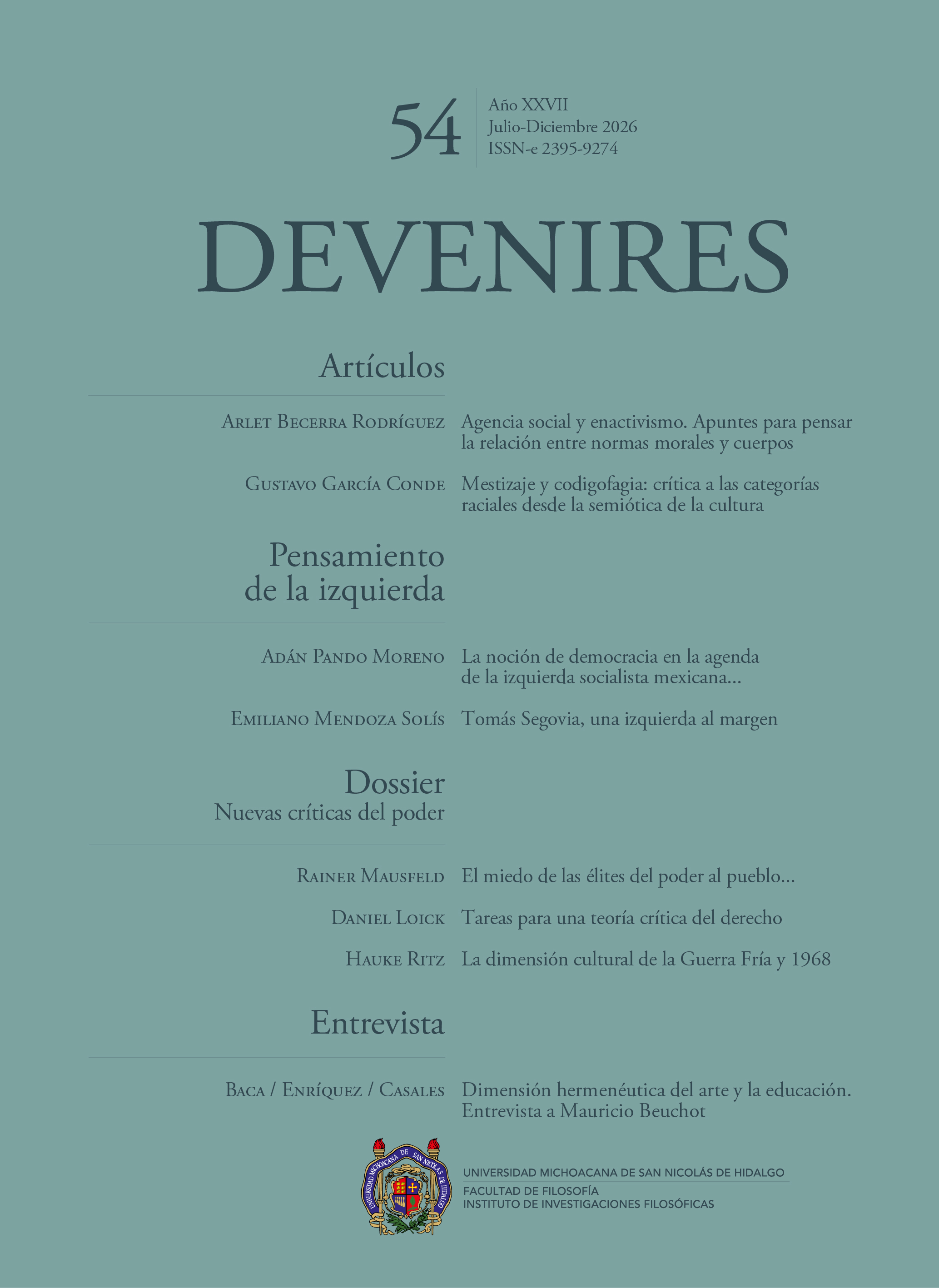
La dimensión cultural de la Guerra Fría y 1968
DOI:
https://doi.org/10.35830/h1q16e62Abstract
Publicado originalmente en: Carsten Gansel y Janine Ludwig (eds.) (2021). 1968 – Ost – West – Deutsch-deutsche Kultur-Geschichten, Berlín, 2021; nueva publicación en: Hauke Ritz (2024). Vom Niedergang des Westens zur Neuerfindung Europas. Frankfurt: Westend Verlag; traducción: Brenda Ramírez Benavides (con apoyo de Deepl). Publicación en español con autorización del autor y de la editorial Westend.
References
Adorno, Theodor W. 1970. Ästhetische Theorie. Fráncfort del Meno: Suhrkamp.
Arendt, Hannah. 1955. Elemente und Ursprünge totaler Herrschaft. Antisemitismus, Imperialismus, totale Herrschaft. Fráncfort del Meno: Europäische Verlagsanstalt .
Borkenau, Franz. 1940. The Totalitarian Enemy. Londres: Ams Pr Inc.
Chomsky, Noam. 1982. Towards a new Cold War. New York: The New Press.
Dussel, Konrad. 2005. “The Triumph of English-Language Pop Music. The West German Radio Programming”. In Between Marx en Coca-Cola. Youth Cultures in Changing European Societies 1960-1980, von Axel Schildt und Detlef Siegried, 131. Nueva York/Oxford.
Gansel, Carsten. 1995. Parlament des Geistes. Literatur zwischen Hoffnung und Repression 1941-61. Berlín: BasisDruck.
Hobsbawn, Eric. 1998. „Der Untergang des Liberalismus”. In Das Zeitatler der Extreme. Weltgeschichte des 20. Múnich.
Hochgeschwender, Michael. 1998. Freiheit in der Offensive. Der Kongress für kulturelle Freiheit und die Deutschen. Múnich.
Horkheimer, Max, und Theodor W Adorno. 1997. „Die Kulturindustrie”. In Dialektik der Aufklärung, 141-191. Fráncfort del Meno: Suhrkamp.
Lauterbach, Reinhard. 2016. Das lange Sterben der Sowjetunion. Schicksalsjahre 1985-1999. Berlín: Edition Berolina.
Mackinder, Halford J. 1904. “The Geographical Pivot to History”. In The Geographic Journal. Londres.
Nixon, Richard. 1959. “The Kitchen Debate”. In Speeches, Writings, Documents, 88 ss. Princeton: University Press.
Popov, Vladimir. 2014a. How the Soviet Elite Lost Faith in Socialism in the 1980s. <https://www.ponarseurasia.org/how-the-soviet-elite-lost-faith-in-socialism-in-the-1980s/> (último acceso el 02/04/2024).
Popov, Vladimir. 2014b. “Socialism is dead, long live socialism!” Munich Personal RePEc Archive. https://mpra.ub.uni-muenchen.de/54294/ 1-45.
Popov, Vladimir. n. d. Prices, Labor Market, Finance, Credit, External Economic Relations in CPE. Was Soviet Economy a Planned One? <https://carleton.ca/vpopov/wp-content/uploads/Prices-labor-market-finance-credit.pdf> (último acceso el 02/04/2024).
Ross, Kristin. 1995. Fast Cars, Clean Bodies. Decolonization and the Reordering of French Culture. Massachusetts: The MIT Press.
Saunders, Frances Stonor. 1999. Who Paid the Piper. The CIA and the Cultural Cold War. Londres: Grant Books.
Schildt, Axel. 1999. Zwischen Abendland und Amerika. Studien zur westdeutschen Ideenlandschaft der 50er Jahre. Múnich.
Stonor, Frances. 1999. Who Paid the Piper? The CIA and the Cultural Cold War. Londres: Granta Books.
Stonor, Frances. 2001. Wer die Zeche zahlt… Der CIA und die Kultur im Kalten Krieg. Múnich: Siedler Verlag.
Taubes, Jacob. 1988. „Ästhetisierung der Wahrheit im Posthistoire”. In Streitbare Philosophie: Margherita von Brentano zum 65. Geburtstag, von
Gabriele Althaus und Irmingard Staeuble. Berlín: Metropol Verlag.
Warner, Michael. 1995. “Origins of the Congress for Cultural Freedom, 1949-50”. https://www.cia.gov/resources/csi/static/origins-congress-cultural-freedom.pdf (último acceso el 02/04/2024). 89-98.
Whitney, Joel. 2016. Finks. How the CIA Tricked the World’s Best Writers. Nueva York/Londres: OR Books.
Zinoviev, Alexander. 2008. “Global Suprasociety and Russia”. Global Research 13-14 <https://www.globalresearch.ca/global-suprasociety-and-russia-the-soviet-counter-revolution-large-scale-subversive-operation-by-the-west/9498> (último acceso el 02/04/2024).
Downloads
Published
Issue
Section
License
Copyright (c) 2026 UMSNH

This work is licensed under a Creative Commons Attribution-NonCommercial-NoDerivatives 4.0 International License.
 Devenires, Año XXVII, Núm. 54, Julio-Diciembre 2026 es una publicación semestral editada por la Universidad Michoacana de San Nicolás de Hidalgo (Santiago Tapia 403, Centro Histórico, Morelia, Michoacán, México, C.P. 58000, Tel. (+52) 44-3322-3500), a través de la Facultad de Filosofía y el Instituto de Investigaciones Filosóficas (Ciudad Universitaria, Edificio C-4, Morelia, Michoacán, México, C.P. 58030, Tel (+52) 44-3322-3500 ext. 4148). Editor responsable: Dr. Federico Marulanda Rey (