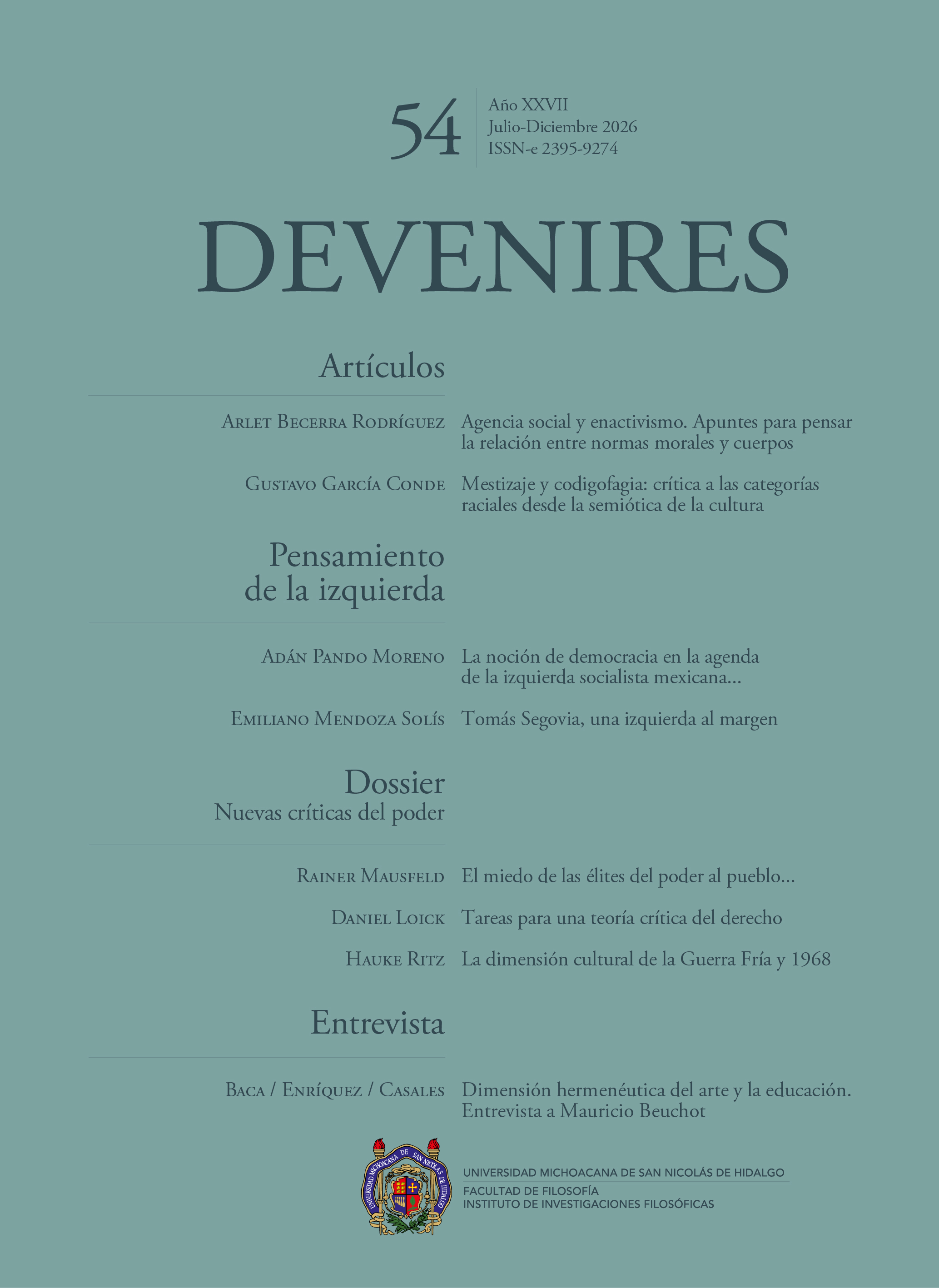
El miedo de las élites del poder al pueblo
Gestión de la democracia mediante técnicas de poder blando
DOI:
https://doi.org/10.35830/tzsb9f04Resumen
Conferencia IPPNW-Hamburgo (organización Jette Limberg Diers) Steiner-Haus Hamburgo, 2 de noviembre de 2016. Elaboración basada en la transcripción de audio realizada por Jette Limberg-Diers. Publicación original como: “Die Angst der Machteliten vor dem Volk – Demokratiemanagement durch Soft-Power-Techniken, en: Warum Schweigen die Lämmer, Frankfurt: Westend. Traducción: Brenda Ramírez Benavides (con apoyo de Deepl). Publicación en español con autorización del autor y de la editorial Westend.
Referencias
Abts, K., & Rummens, S. (2007). Populism versus Democracy. Political Studies, 55, 405-424.
Adler, H. (2007). Nützt es dem Volke, betrogen zu werden? Est-il utile au Peuple d’être trompé? (2 volúmenes). Stuttgart: Frommann-Holzboog.
Arendt, H. (1963). Über die Revolution. Múnich: Piper.
Blum, W. (2004). Killing Hope. U.S. Military and C.I.A Interventions since World War II. Monroe: Common Courage Press.
Carey, A. (1997). Taking the Risk out of Democracy. University of Illinois Press.
Chomsky, N. (1992). Deterring Democracy. Londres: Vintage.
Chomsky, N. (2017). Hegemonie oder Untergang: Amerikas Streben nach Weltherrschaft. Fráncfort: Nomen.
Coates, B. A. (2016). Legalist Empire: International Law and American Foreign Relations in the Early Twentieth Century. Oxford University Press.
Dahn, D. (2013). Wir sind der Staat. Warum Volk sein nicht genügt. Hamburgo: Rowohlt.
Domhoff, G. W. (1990). The power elite and the state: How policy is made in America. Hawthorne, NY: Aldine de Gruyter.
Domhoff, G. W. (2013). The myth of liberal ascendancy: Corporate dominance from the Great Depression to the Great Recession. Boulder: Paradigm Publishers.
Domhoff, G. W. (2014). Who rules America? The triumph of the corporate rich. Nueva York: McGraw-Hill.
Farrant, A. & McPhail, E. . (n.d.). Can a dictator turn a constitution into a can-opener? F.A. Hayek and the alchemy of transitionsl dictatorship in Chile. Review of Political Economy, 26, 331-348.
Finley, M. (1973). Antike und moderne Demokratie. Stuttgart: Reclam.
Fones-Wolf, E. A. (1997). Selling Free Enterprise. The Business Assault on Labor and Liberalism 1945-1960. University of Illinois Press.
Fraser, S. (2015). The Age of Acquiescence: The Life and Death of American Resistance to Organized Wealth and Power. Nueva York: Little Brown.
Friedman, M. P. (2012). Rethinking Anti-Americanism: The History of an Exceptional Concept in American Foreign Relations. Cambridge University Press.
Gear, A., & Burns, W. H. (2015). The Betrayal of Human Rights and the Urgency of Universal Corporate Accountability: Reflections on a Post-Kiobel
Lawscape. Human Rights Law review, 21-44. http://www.institut-fuer-menschenrechte.de/aktuell/news/meldung/article/rechtsstreit-kiobel-versus-shell-verpasste-chance-zur-staerkung-zivilgerichtlicher-hilfe-bei-schw/.
Gilens, M. & Page, B.I. (2014). Testing Theories of American Politics: Elites, Interest Groups, and Average Citizens. 564-581.
Hitchens, C. (2001). Die Akte Kissinger. Múnich: dva.
Hofstetter, R. (1963). Anti-intellectualism in American Life. Nueva York: Knopf.
Huxley, A. (1958). Brave New World Revisited. Nueva York: Harper.
Ignatieff, M. (2002). Barbarians at the Gate? New York Review of Books, 28. February 2002.
Illich, I. (1971/2003). Entschulung der Gesellschaft. Eine Streitschrift. Múnich: Beck.
Ingeborg. (1991). Sinn und Bedeutung von Volkssouveränität in der modernen Gesellschaft. Kritische Justiz, 24, 137-150.
Johnson, C. (2004). The Sorrows of Empire: Militarism, Secrecy, and the End of the Republic. Nueva York: Henry Holt.
Kelsen, H. (1920). Vom Wesen und Wert der Demokratie. Tübingen: Mohr.
Kennan, G. F. (n.d.). Memorandum PPS23 del 28 de febrero de 1948, publicado el 17 de junio de 1974.
Kinzer, S. (2006). Overthrow: America’s Century of Regime Change From Hawaii to Iraq. Nueva York: Time Books.
Koskenniemi, M. (2004). International law and hegemony: a reconfiguration. Cambridge Review of International Affairs, 17, 197-218.
Lasswell, H. D. (1927). Propaganda Technique in The World War. Nueva York.
Lofgren, M. (2016). The Deep State: The Fall of the Constitution and the Rise of a Shadow Government. Nueva York: Penguin.
Ludwig, O. (1988). Der Schulaufsatz: seine Geschichte in Deutschland. Berlín: De Gruyter.
Lynd, R. S. (1949). The Science of Inhuman Relations. The New Republic, 121, 22-25.
Maier, C. S. (2006). Among Empires: American Ascendancy and its Predecessors. Harvard University Press.
Manin, B. (2007). Kritik der repräsentativen Demokratie. Berlín: Matthes & Seitz.
Markel, L. (1949). Public Opinion and Foreign Policy. Council of Foreign Relations. Nueva York: Harper & Brothers.
Maus, I. (2011). Über Volkssouveränität – Elemente einer Demokratietheorie. Berlín: Suhrkamp.
McClintock, M. (1992). Instruments of Statecraft: U.S. Guerilla Warfare, Counter-Insurgency, Counter-Terrorism. Nueva York: Pantheon Books.
McCrisken, T. B. (2002). Exceptionalism. In A. Deconde, R. D. Burns, F. Logevall, & L. Ketz, Encyclopedia of American Foreing Policy, Vol. 2, segunda
edición (pp. 63-80). Nueva York: Scribner.
McCrisken, T.B. (2003). American Exceptionalism and the Legacy of Vietnam: US Foreign Policy since 1974. Nueva York: Palgrave Macmillan.
Meadowcroft, J., & Ruger, W. (2014). Hayek, Friedman, and Buchanan: On Public Life, Chile, and the Relationship between Liberty and Democracy. Review of Political Economy, 26, 358-367.
Mearsheimer, J. J. (2003). Why leaders lie. Oxford University Press.
Mégret, F. (2002). The Politics of International Criminal Justice. European Journal of International Law, 5, 1261-1284.
Michels, R. (1911). Zur Soziologie des Parteiwesens in der modernen Demokratie. Untersuchungen über die oligarchischen Tendenzen des Gruppenlebens. Leipzig: Klinkhardt.
Mises, L. (1927). Liberalismus. Jena: Fischer.
Mudde, C. (2004). The Populist Zeitgeist. Goverment and Opposition, 39, 541-563.
Mudde, C. (2007). Populist Radical Right Parties in Europe. Cambridge University Press.
Nedelsky, J. (1990). The Madison Framework. Private Property and the Limits of American Constitutionalism. University of Chicago Press.
Nippel, W. (2008). Antike oder moderne Freiheit? Die Begründung der Demokratie in Athen und in der Neuzeit. Fránfort: Fischer.
Nugent, W. (n.d.). Habits of Empire: A History of American Expansion. Nueva York: Knopf.
Parchami, A. (2009). Hegemonic Peace and Empire: The Pax Romana, Britannica and Americana. Londres: Routledge.
Pitkin, H. F. (2004). Representation and Democracy: Uneasy Alliance. Scandinavian Political Studies, 27, 335-342.
Rittstiege, H. (1975). Eigentum als Verfassungsproblem. Darmstadt: Wissenschaftliche Buchgesellschaft.
Roberts, J. T. (1994). Athens on Trial. Princeton University Press.
Roelofs, J. (2003). Foundations and Public Policy: The Mask of Pluralism. Albany, NY: State University of New York Press.
Roy, A. (2003). Public Power in the Age of Empire. Seven Stories Press.
Russell, B. (1922). Free Thought And Official Propaganda. Nueva York: Watts.
Saage, R. (2005). Demokratietheorien. Historischer Prozess – Theoretische Entwicklung – Soziotechnische Bedingungen: Eine Einführung. Wiesbaden: Verlag für Sozialwissenschaften.
Sachs, J. D. (2011). The Price of Civilization: Reawakening American Virtue and Prosperity. Nueva York: Random House.
Saito, N. T. (2010). Meeting the Enemy: American Exceptionalism and International Law. New York University Press.
Saunders, F. S. (2001). Wer die Zeche zahlt ...: Der CIA und die Kultur im Kalten Krieg. Múnich: Siedler.
Schabas, W. (2012). Unimaginable Atrocities: Justice, Politics, and Rights at the War Crimes Tribunals. Oxford University Press.
Shoup, L. (2015). Wall Street’s Think Tank: The Council on Foreign Relations and the Empire of Neoliberal Geopolitics, 1976-2014. Nueva York: Monthly Review Press.
Simpson, C. (1994). The Science of Coercion. Communication Research & Psychological Warfare 1945-1960. Oxford University Press.
Strauss, L. (1995). Liberalism Ancient and Modern. University of Chicago Press.
Tasca, A. (1938). La naissance du fascisme: l’Italie de 1918 à 1922. Paris : Gallimard.
Tasca, A. (1986). Glauben, gehorchen, kämpfen: Aufstieg des Faschismus in Italien. Viena: Promedia.
Taylor, T. (1993). The Anatomy of the Nuremberg Trials: A Personal Memoir. Nueva York: Little Brown.
Turse, N. (2017). Special Ops, Shadow Wars, and the Golden Age of the Gray Zone. Tom Dispatch.com. http://www.tomdispatch.com/post/176227/. From https://tomdispatch.com/nick-turse-special-ops-shadow-wars-and-the-golden-age-of-the-gray-zone/
Valentine, D. (2017). The CIA as Organized Crime: How Illegal Operations Corrupt America and the World. Atlanta: Clarity Press.
Vine, D. (2015a). The United States Probably Has More Foreign Military Bases Than Any Other People, Nation, or Empire in History. The Nation, September 14. https://www.thenation.com/article/the-united-states-probably-has-more-foreign-military-bases-than-any-other-people-nation-or-empire-in-history/.
Vine, D. (2015b). Base Nation: How U.S. Military Bases Abroad Harm America and the World. Nueva York: Henry Holt.
Weber, M. (1988). Gesammelte politische Schriften. Tübingen: Mohr.
Wolin, S. (2004). Politics and Vision: Continuity and Innovation in Western Political Thought. Princeton University Press.
Wood, E. M. (2010). Demokratie contra Kapitalismus. Neuer ISP Verlag.
Descargas
Publicado
Número
Sección
Licencia
Derechos de autor 2026 UMSNH

Esta obra está bajo una licencia internacional Creative Commons Atribución-NoComercial-SinDerivadas 4.0.
 Devenires, Año XXVII, Núm. 54, Julio-Diciembre 2026 es una publicación semestral editada por la Universidad Michoacana de San Nicolás de Hidalgo (Santiago Tapia 403, Centro Histórico, Morelia, Michoacán, México, C.P. 58000, Tel. (+52) 44-3322-3500), a través de la Facultad de Filosofía y el Instituto de Investigaciones Filosóficas (Ciudad Universitaria, Edificio C-4, Morelia, Michoacán, México, C.P. 58030, Tel (+52) 44-3322-3500 ext. 4148). Editor responsable: Dr. Federico Marulanda Rey (